The True Source of Wisdom

From The Desk | The Gentlemen’s Study
I was in Proverbs 2 this morning.
As I have mentioned before, part of my daily Bible reading, I read the chapter in Proverbs that corresponds to the date. Thirty-one chapters. One for nearly every day of the month. It is a simple practice, but one of its great benefits is that it keeps bringing me back to passages I might otherwise read once, nod at, and move past.
This morning, verse six caused me to pause and ponder.
For the LORD gives wisdom;
from his mouth come knowledge and understanding.
— Proverbs 2:6
There is an entire philosophy of knowledge contained in that one sentence. It tells us where wisdom comes from, how we receive it, and why the truly wise man can never become proud of possessing it.
It also corrects one of the most persistent mistakes made by intelligent men: the belief that wisdom is something we manufacture for ourselves.
The Difference Between Intelligence and Wisdom
We live in an age with almost unlimited access to information. A man can carry more facts in his pocket than the greatest libraries of the ancient world could hold. He can summon an answer to almost any question within seconds. He can listen to lectures, read articles, follow experts, and consume a constant stream of explanation and opinion from the moment he wakes until the moment he goes to sleep.
And yet none of that guarantees wisdom.
Information can tell a man what is happening. Knowledge can help him understand how something works. Intelligence may allow him to analyze a problem faster than the people around him.
Wisdom answers a different question.
What should I do?
How should I live?
What is true, what is good, and what is worth pursuing?
How do I take what I know and place it in the proper order under God?
A man can be highly educated and still ruin his family. He can be professionally accomplished and still be governed by appetite, pride, anger, or fear. He can speak confidently about politics, theology, history, or culture and still lack the judgment to know when to speak, when to remain silent, when to act, and when to wait.
That man may be informed. He may even be brilliant.
But he is not necessarily wise.
The Verse Begins With God
Proverbs 2:6 does not say that the Lord merely approves of wisdom. It does not say that He recognizes it when men achieve it or rewards those intelligent enough to discover it.
It says He gives it.
That means wisdom does not begin with the man seeking it. It begins with the God who possesses it and gives it according to His grace.
That distinction matters because it changes the posture of the entire pursuit.
If wisdom is my achievement, then it becomes another reason to think highly of myself. I read more than other men. I have lived longer. I have made difficult decisions. I have accumulated experience. I have learned from mistakes. Therefore, I am wise.
But if the Lord gives wisdom, then anything genuinely wise in me is received before it is possessed. I may have pursued it seriously. I may have studied, listened, reflected, and learned through years of experience. But I did not create the truth I came to understand. I did not establish the moral order I am learning to recognize. I did not give myself the mind with which I perceive it.
I am a recipient.
That is why genuine wisdom and genuine humility belong together. The wiser a man becomes, the more clearly he should see how dependent he is upon God for everything he knows rightly.
The proud man may know many things. But pride is already evidence that he has misunderstood the most important thing about them.
From His Mouth
The second half of the verse is just as important as the first.
“From his mouth come knowledge and understanding.”
God has not left us to search for wisdom in the dark. He has spoken.
This is where the Christian understanding of wisdom separates itself from vague spirituality and self-help. We are not told to look deeply within ourselves until we discover a private truth that was waiting there all along. We are not told to follow every strong impression, trust every instinct, or treat our own desires as though they carry divine authority.
Wisdom comes from the mouth of God.
For us, that means His Word. Scripture is not one source of wisdom among many equally authoritative voices. It is the standard by which every other voice is judged—including our own.
That is not to say there is nothing to learn outside the pages of the Bible. The world is filled with knowledge worth acquiring. History teaches. Experience teaches. Good books teach. Older men teach. Failure can be a severe but effective instructor. Through common grace, even men who do not acknowledge God can observe His world accurately and say things that are true.
But none of those sources is ultimate. Every lesson, idea, tradition, and piece of advice must eventually stand before what God has spoken.
A man does not become wise merely by collecting more voices. He becomes wise by learning which voice governs all the others.
Seeking What Only God Can Give
There is something else in this chapter that deserves attention.
The verses immediately preceding verse six tell the reader to receive wise words, treasure commandments, make his ear attentive, incline his heart, call out for insight, and seek wisdom as he would seek silver or hidden treasure.
Then comes verse six:
“For the LORD gives wisdom.”
At first glance, those two ideas might seem to pull in opposite directions. Are we supposed to work diligently for wisdom, or are we supposed to receive it as a gift?
Proverbs answers: yes.
The fact that wisdom is given does not make the pursuit unnecessary. It makes the pursuit dependent. We read because God has spoken. We study because truth is worth understanding. We listen because pride makes us poor judges of the limits of our own knowledge. We pray because no amount of study can make the human heart see clearly apart from God’s grace.
The effort is real. But the effort is not sovereign.
This is a pattern found throughout the Christian life. We work, but God supplies. We seek, but God reveals. We discipline ourselves, but we do not transform ourselves by force of will. We use the means He has provided while recognizing that the fruit remains His gift.
That protects a man from two equal and opposite errors.
The first is laziness disguised as dependence: “If God gives wisdom, I do not need to do the hard work of pursuing it.” Proverbs will not allow that. The chapter describes a man searching as though treasure were buried beneath his feet.
The second is self-reliance disguised as discipline: “If I read enough, study enough, and accumulate enough experience, I can make myself wise.” Proverbs will not allow that either. The Lord gives wisdom. It comes from His mouth.
The wise man works diligently with an open Bible and a dependent heart.
Wisdom Is Moral Before It Is Impressive
One of the great temptations in pursuing wisdom is wanting to appear wise.
We want the good answer in the room. We want to be the man others consult. We want the reputation for judgment, depth, and insight. And because that reputation is flattering, it is possible to pursue the appearance of wisdom while quietly avoiding the obedience that wisdom requires.
But biblical wisdom is not a performance of intelligence. It is truth lived rightly before God.
The fear of the Lord is the beginning of knowledge. That means wisdom begins not with intellectual confidence but with reverence, submission, and the recognition that God is God and we are not.
The test of wisdom is therefore not merely whether a man can explain the right course. It is whether he walks in it.
Does his knowledge make him more faithful?
Does his theology make him more humble?
Does his experience make him more patient with younger men who have not yet acquired it?
Does his reading make him easier to teach—or simply harder to impress?
Does he obey what God has already made plain while asking for guidance about what remains unclear?
There is little value in asking God for wisdom regarding some great future decision while disregarding what He has already said about honesty, purity, self-control, forgiveness, work, marriage, worship, and the use of our words.
Often, our problem is not that God has failed to give direction. It is that we are hoping for different direction.
Wisdom Has a Name
The New Testament takes this even further.
Paul describes Christ as “the power of God and the wisdom of God.” Elsewhere he writes that in Christ “are hidden all the treasures of wisdom and knowledge.”
Christian wisdom is therefore not merely a collection of reliable principles. It is inseparable from a Person.
We do not come to Christ because He helps us become slightly wiser versions of the men we already are. We come because our deepest problem is not a shortage of information. It is sin. We do not merely need better advice. We need redemption, a new heart, and the work of the Holy Spirit conforming us to the One who is Himself the wisdom of God.
That is where every merely secular system of wisdom eventually reaches its limit. It may identify good habits. It may describe admirable virtues. It may teach restraint, courage, reflection, and composure. Much of that may be genuinely useful.
But it cannot reconcile a man to God. It cannot forgive sin. It cannot raise a spiritually dead heart or produce holiness from the inside out.
The Christian does not reject every insight found outside the faith. He simply refuses to mistake a signpost for the destination.
The true source of wisdom is God. God has spoken in His Word. And the fullness of His wisdom is revealed in Christ.
Awhile back we discussed the Stoics and the Stoic philosophy. I made clear that I take the time to read and attempt to understand their points, which have validity and practical value for living. There is also wisdom in many of their words. While I admire and appreciate them, I also realize they have their place and that their wisdom falls short. I will go to Solomon over Socrates any day, and I value the words of Christ far superior to an Aurelius, Epictetus, or Seneca without hesitation. For True wisdom, there is none higher than the Creator.
The Question Worth Considering
Proverbs 2:6 leaves me with a question that reaches beyond what I read this morning.
When I need wisdom, where do I actually go first?
Do I begin with Scripture and prayer—or do I begin with my own instincts and ask God to confirm them afterward?
Do I want wisdom badly enough to seek it like treasure, or do I merely want quick guidance when a decision becomes uncomfortable?
And perhaps most searching of all: am I asking God to make me wise, or merely to make me look right?
The distinction is not small.
The world has no shortage of information, opinions, experts, or confident men. What it lacks is wisdom—the kind that begins in the fear of the Lord, receives truth as a gift, submits every competing voice to what God has spoken, and then walks obediently in the light it has been given.
That wisdom cannot be manufactured.
It can only be received.
And the Lord is its source.
Pull up a chair. You’re welcome here.
— Keith
The Value of Time Well Spent

From The Desk | The Gentlemen's Study
Something I said in the last episode apparently ruffled some feathers. Whether it was misunderstood, taken out of context, or a failure on my part to accurately communicate my point necessitates a response.
I talked, in that episode, about my own history with sports. About the hundreds — probably thousands — of hours I spent over the years watching games. Genuinely entertained by them, genuinely invested in them, the way a lot of men are. And I talked honestly about how, looking back now, I've come to see that time differently than I did while I was living it.
Some of you heard that as an attack on sports fans. I want to clear that up, and then I want to go further into the actual argument.
What I Was Not Saying
I was not saying sports are a waste of time. I was not saying the men who love watching them are doing something wrong. I was not passing judgment on anyone's Saturday afternoon, and I was not suggesting that a man who enjoys football or baseball or whatever his game happens to be is somehow failing at the pursuit of virtue this show is built around.
I like sports. I have loved sports. There is real good in them — genuine athletic excellence worth admiring, shared experience with friends and family, the specific kind of communal joy that comes from caring about something together with other people. None of that is nothing. I was not arguing that it is.
What I was doing was something more personal and more specific. I was describing my own honest accounting of my own hours — and asking, out loud, on the air, whether the ratio I had settled into for a long stretch of my life was actually the ratio I wanted, in hindsight. I found myself lacking, and I found in my honest self-evaluation that I wasted too many hours that could have been better spent.
The Actual Argument
Here is what I actually believe.
Time is the one resource no man gets more of. You cannot save it, cannot earn it back, cannot borrow against a future supply of it. Every hour spent is an hour permanently gone, spent on exactly one thing and nothing else, forever.
That is true of every hour, including the hours spent on things I enjoy. It was true of the hours I spent watching games. It is true of the hours I now spend reading, writing, sitting on the patio with a cigar, or writing outlines, posts, and episodes for this show.
None of that means every hour has to be maximally productive or self-improving. I am not building a case for a life with no rest, no entertainment, no simple enjoyment. I said as much in the episode on presence and again in the episode on the man cave versus the study — rest matters, leisure matters, a man who never stops is not more virtuous, he is simply more depleted.
The question I was actually raising is narrower and, I think, harder to argue with once you give it an honest evaluation. When I look back at a specific stretch of my life where sports occupied a genuinely large share of my available leisure hours, what did those specific hours actually produce, compared to what the same hours might have produced if I had spent even a portion of them differently?
A game I watched ten years ago is gone. I could not tell you the score today if my life depended on it. I remember almost nothing specific about most of those hours — not because I wasn't paying attention at the time, but because that is simply the nature of that kind of content. It is built for the moment. It does not accumulate and it carries no lasting value.
A book I read ten years ago is still shaping how I think, right now, today. An idea I encountered in my twenties still surfaces in conversations I have in my fifties. That is the nature of that kind of content too. It does accumulate, compounding quietly over years in a way that entertainment consumed for its own sake generally does not.
That is not a moral claim about the people involved. It is simply an honest observation about two different kinds of hours, and what they tend to leave behind.
Why This Isn't About Sports Specifically
I want to be clear that sports were simply the example that happened to be true of my own history — the specific thing I personally spent a large share of my leisure time on for a long stretch of years. The argument isn't really about sports at all. While there are other arguments I could and do make against sports, this one wasn’t ONLY about sports. It applies just as directly to any hour spent on content built for the moment rather than content built to last.
Hours spent scrolling. Hours spent on shows that are pleasant but forgettable. Hours spent anywhere that produces genuine, real-time enjoyment and then leaves behind almost nothing once the moment has passed.
I am not asking any man to eliminate those hours from his life entirely. I am asking him to actually look at the ratio — honestly, without defensiveness, the same way I had to look honestly at my own — and decide whether it reflects what he actually wants his hours to be building over the long run of an entire life.
The Question Worth Asking Yourself
Here is the version of the question I'd actually put to any man, sports fan or otherwise, and it is the same question I had to put to myself before I ever said a word about it on the air.
If you added up every hour you spent last year on content built purely for the moment — and then added up every hour spent on something built to accumulate, to shape you, to still matter to you a decade from now — what would that ratio actually look like?
I am not asking you to feel guilty about the answer. I asked myself the same question and did not love what I found either. That is precisely why I brought it up on the show in the first place — not from a position of having already solved it, but from the position of a man who is still working it out himself, in real time, one week at a time.
The point was never that sports are completely bad. The point is that every hour is doing something to you, whether you're paying attention to that fact or not. And it is worth occasionally stopping to ask what your hours have actually been building.
Pull up a chair. You're welcome here.
— Keith
Why Men of Virtue Are Needed Now More Than Ever
From The Desk | The Gentlemen's Study
I have spent many years watching what happens when a man's character fails under pressure.
Not the dramatic failures — those get investigated, reported, remembered. I mean the smaller ones. The corner cut when no one was looking. The word not kept because keeping it became inconvenient. The temper that finally broke after years of never quite being governed. The private man who turned out to be someone entirely different from the public one.
Every one of those failures had a moment before it — a moment where character was either being built or was quietly eroding, long before the failure itself became visible. By the time the failure happened, the outcome had already been decided. Not in that moment. In the thousand smaller moments that led to it.
That is why this show exists. And it is why I want to make the case, directly, for something that has become unfashionable to say plainly.
We need more men of virtue.
The Vacuum We Are Living In
Look at what currently fills the space where a serious vision of manhood used to stand.
On one side, an entire cultural apparatus insisting that the traditional qualities of manhood — strength, resolve, leadership, the willingness to bear weight others cannot — are inherently suspect. That the healthiest man is the most diminished one. That ambition and confidence are problems to be managed rather than strengths to be stewarded.
On the other side, a countercurrent that has decided the answer to that diminishment is volume. Dominance mistaken for strength. Aggression mistaken for courage. Confidence performed loudly enough to be mistaken for the real thing, by an audience that has forgotten what the real thing actually looks like.
Neither of these is a vision of manhood worth pursuing. And most men — even the ones performing one of these two roles convincingly — know it. There is a hollowness underneath both postures that no amount of either apologizing or posturing actually fills.
Into that vacuum, virtue is the answer nobody is currently offering loudly enough.
What Virtue Actually Does
I want to be precise about why this matters beyond the individual man, because the case for virtue is not merely a case for personal improvement. It is a case for the health of everything a man touches.
The man of integrity is trustworthy in a world starving for trustworthy men. His word means something. His commitments hold. The people who depend on him — his wife, his children, his employer, his church, his community — do not have to wonder which version of him they are going to get.
The man of composure is a stabilizing presence in a culture that has forgotten what stability looks like. He does not add to chaos. He absorbs it. He is the person others call when things go wrong, because they know he will not make the situation worse by losing himself in it.
The man of loyalty is an anchor in an era of easy exits — where every commitment, every relationship, every obligation has become negotiable the moment it grows costly or inconvenient. He is the man who stays. And staying, in this particular moment, has become countercultural enough to be remarkable.
The man of justice defends what is right even when defending it costs him something. He does not merely avoid wrongdoing and call that virtue. He acts. He speaks. He bears weight that silence would have let him avoid.
None of these men are performing virtue for an audience. They simply are what they appear to be — and that consistency, multiplied across a family, a workplace, a community, a nation, is not a small thing. It is the difference between a society that functions and one that is quietly coming apart at the seams while everyone wonders why.
The Cost of Drift
Here is what I think most men do not fully reckon with. Character is not a neutral, static thing that simply sits still while the rest of life happens around it.
It is either being built, deliberately, through the accumulation of a thousand small decisions made with intention — or it is eroding, just as steadily, through drift. Through the absence of attention. Through a life lived reactively rather than on purpose.
There is no third option where a man simply pauses his own formation and waits to decide later what kind of man he wants to be. The waiting itself is a decision. And it is, almost always, the decision that produces the least virtuous version of the man in question — not because he chose badness, but because he never chose anything at all, and drift has a direction of its own.
The men who raised the sons who become the fathers of the next generation, who lead the families and communities and institutions that either hold together or come apart — those men were formed by something. The only real question, for every man reading this, is whether that formation was intentional.
What This Costs the People Around Him
I want to say something directly to any man reading this who thinks the pursuit of virtue is a private, individual matter with no real bearing on anyone else.
It absolutely is not.
Every virtue a man builds — or fails to build — ripples outward into every relationship he holds. His wife experiences directly whether he is a man of composure or a man ruled by his temper. His children learn what manhood looks like not from what he tells them but from what he actually does, day after day, in moments he never realized were being watched. His community either gains a man who can be counted on or loses one more variable it cannot predict.
I think of a young married couple I once responded to on a domestic call early in my career. A man whose faith and character had, in that single moment, not been built deeply enough to hold under pressure — with consequences that reached far beyond himself in the space of a few seconds. Most failures of virtue are quieter than that. But they are not smaller in their cumulative effect. They simply take longer to become visible.
A culture full of men who have not built genuine character does not merely produce individually unfortunate outcomes. It produces a civilization that cannot hold together — because civilization, at every level, is simply the accumulated character of the men and women who make it up.
The Invitation
I am not writing this to condemn anyone. I have my own list of virtues still under construction, still contested, still requiring daily attention I do not always give them.
I am writing it because I believe, with real conviction, that the recovery of a serious vision of masculine virtue is one of the most urgently needed things in front of us right now — not as a nostalgic return to some imagined past, but as the only durable answer to a vacuum that both extremes of the current cultural conversation have failed to fill.
The man who reads seriously. Who examines his own life honestly. Who holds his convictions with humility and his commitments with resolve. Who is the same man in every room he enters. Who governs his appetites rather than being governed by them. Who treats the people who can do nothing for him with the same regard he shows the people who can do everything for him.
That man is not a relic. He is not old-fashioned in any sense that should embarrass him. He is, in fact, exactly what this moment requires — and there are not nearly enough of him yet.
We need more men like that.
I am trying to become one. I hope you are too.
Pull up a chair. You're welcome here.
— Keith
Cigars, Whiskey, and the Glory of God
A word to the listener who wonders how I reconcile the patio with the pew
From the Desk/The Gentlemen’s Study
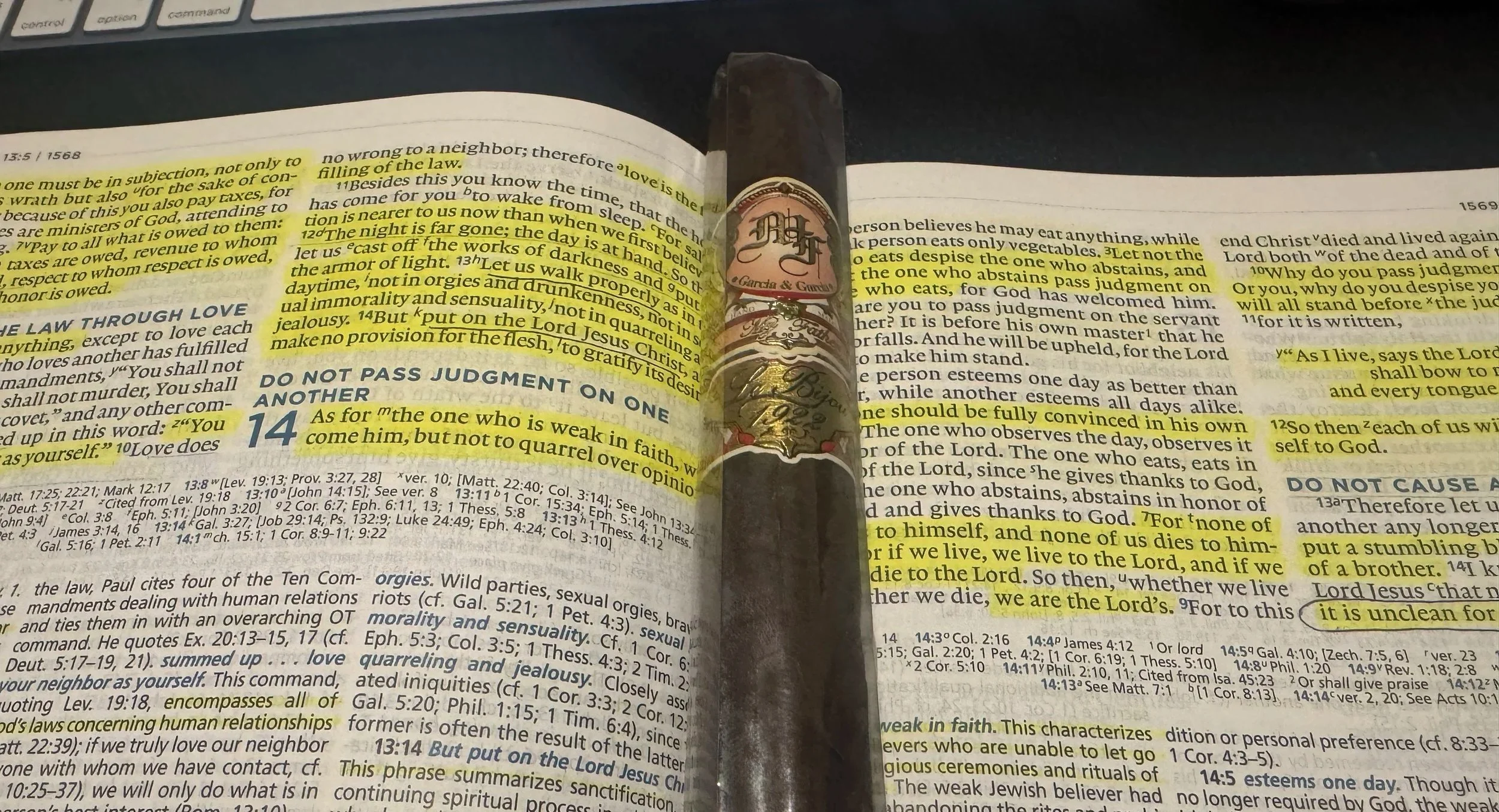
I get the question from time to time. Since the podcast has begun, I have gotten it a couple of times from listeners and I assume it will come more and more with the growth of the show. Someone listens to an episode, hears me mention the My Father Le Bijou I enjoyed on the patio the night before or the pour of Woodford Reserve Double Oaked that accompanied a good book, and they write in to ask — sometimes with genuine curiosity, sometimes with concern — how I reconcile that with being a Christian.
It's a fair question. And because it keeps coming, I want to answer it properly rather than in passing. Not defensively. Not apologetically. But theologically — because that's where the answer actually lives.
The short answer is this: a cigar and a glass of whiskey enjoyed in moderation are not sin. The Bible does not say they are. And the attempt to make them sin — to build a prohibition that Scripture does not build — is not holiness. It is legalism. Those are two very different things, and a gentleman ought to know the difference.
What the Apostle Paul Actually Said
The clearest framework for this conversation comes from the Apostle Paul, and he addressed it directly — not because cigars existed in the first century, but because the underlying question is timeless: what freedoms does the Christian have in areas the Bible does not explicitly prohibit?
In Romans 14, Paul is addressing a real dispute in the early church over food sacrificed to idols and the observance of certain days. His counsel is careful and nuanced. He distinguishes between what Scripture commands and what individual conscience may require. He writes:
"One person believes he may eat anything, while the weak person eats only vegetables. Let not the one who eats despise the one who abstains, and let not the one who abstains pass judgment on the one who eats, for God has welcomed him."
— Romans 14:2–3
The principle Paul is establishing is Christian liberty — the freedom a believer has in areas where God has not spoken a prohibition. The strong believer, the one who understands his freedom in Christ, is not to be condemned by the one who, out of personal conviction, abstains. And vice versa — the one who enjoys the freedom is not to look down on the one who does not.
Paul extends this principle in 1 Corinthians 10:31, where he writes:
"So, whether you eat or drink, or whatever you do, do all to the glory of God."
— 1 Corinthians 10:31
This is the theological hinge of the entire question. The issue is not whether a cigar or a glass of whiskey exists on a list of forbidden things — they don't. The issue is whether you can enjoy them in a manner that honors God. Whether they are held loosely, governed by self-control, and kept in their proper place. That is the standard Scripture actually sets.
The Conscience Clause
Paul does add an important qualification that any honest treatment of this subject must include. In Romans 14:23 he writes: "Whatever does not proceed from faith is sin." And earlier in the same chapter: "Each one should be fully convinced in his own mind."
What this means practically is that Christian liberty is not a license to override your own conscience. If a man is personally convicted that he should not drink whiskey — not because the Bible forbids it, but because of his own history, weakness, or conscience before God — then he should abstain. To violate your own conscience, even in something Scripture permits, is sin for that man.
This is why I am not here to tell every Christian gentleman to light a cigar and pour a drink. There are men for whom total abstinence is the right and wise choice — because of a history with alcohol, because of a tendency toward excess, because of a weak brother nearby who would be harmed by the example. Paul addresses all of that too, and it deserves to be taken seriously.
What I am saying is simply this: abstinence is not automatically holiness, and enjoyment is not automatically sin. The determining factors are conscience, self-control, and whether the thing is received with gratitude and kept in its proper place.
Where Sin Actually Lives
Scripture is clear about where the line is drawn. The sins Paul names are drunkenness and gluttony — not drinking and eating. Galatians 5:21 lists drunkenness among the works of the flesh. Proverbs 23:20–21 warns against those who drink to excess. The prohibition is on overconsumption, on the loss of self-control, on appetite that has become master rather than servant.
The issue is not the substance. The issue is self-control — the fruit of the Spirit that governs all of our appetites, not just the culturally acceptable ones.
I track my cigar and drink consumption deliberately — not because I believe two cigars a week and an occasional pour of bourbon are sins requiring management, but because I believe any appetite left unexamined tends to expand. The man who governs his appetites is a free man. The man whose appetites govern him is not — regardless of what substance is involved.
What Legalism Actually Is
There is a word for the practice of building moral prohibitions that Scripture does not build, and adding them to the law of God as though they carry the same weight: legalism. It is not a minor error. Paul addresses it sharply in Colossians 2:20–23, asking: "If with Christ you died to the elemental spirits of the world, why, as if you were still alive in the world, do you submit to regulations — Do not handle, Do not taste, Do not touch?" He calls these things regulations "according to human precepts and teachings" and notes that they have "an appearance of wisdom in promoting self-made religion and asceticism," but are of no value against the indulgence of the flesh.
The appearance of wisdom. That is a precise and sobering description. Legalism looks serious. It sounds holy. But what it actually does is substitute human tradition for biblical authority and in doing so, it binds consciences that Christ has set free.
I say this not to be dismissive of the brother or sister who personally abstains — that choice can be genuinely wise and godly. I say it because the posture of treating abstinence as the only acceptable Christian position, and looking sideways at the man who enjoys a cigar on his patio, is a posture Scripture does not support.
The Prince of Preachers Had Something to Say About This
Charles Haddon Spurgeon — the Prince of Preachers, the most celebrated Baptist minister of the nineteenth century, a man whose sermons are still read and studied worldwide — was a well-known and unapologetic cigar smoker. He made no attempt to hide it and saw nothing wrong with it.
The most documented account of his position came in 1874 at the Metropolitan Tabernacle. Spurgeon had invited the American Baptist pastor Dr. George Pentecost to share the pulpit. Spurgeon preached on the necessity of giving up sin, and then invited Pentecost to make the application. Pentecost — unaware that Spurgeon smoked — proceeded to preach passionately against cigars, sharing his own struggle to give them up and declaring the practice sinful for a Christian.
When Pentecost sat down, Spurgeon rose. The congregation held its breath. What he said is documented in Arnold Dallimore's biography of Spurgeon:
"Well, dear friends, you know that some men can do to the glory of God what to other men would be sin. And notwithstanding what brother Pentecost has said, I intend to smoke a good cigar to the glory of God before I go to bed tonight."
— Charles Spurgeon, Metropolitan Tabernacle, 1874
The statement caused considerable public controversy. Spurgeon responded in a letter to the editor of the Daily Telegraph — not by backing down, but by explaining his theology with characteristic clarity:
"No Christian should do anything in which he cannot glorify God; and this may be done, according to Scripture, in eating and drinking and the common actions of life. When I have found intense pain relieved, a weary brain soothed, and calm, refreshing sleep obtained by a cigar, I have felt grateful to God, and have blessed His name."
— Charles Spurgeon, letter to the Daily Telegraph, 1874
It is worth noting that some versions of the Tabernacle quote add the phrase "it is a kind of incense drifting to heaven," and while that colorful addition circulates widely, it does not appear in Dallimore's sourced account. The core statement — that he intended to smoke a good cigar to the glory of God — is well-documented and indisputably Spurgeon's own words.
So Here Is Where I Land
I smoke a cigar most weekends. I enjoy a pour of Bourbon, Rye, or Scotch on occasion — never a second pour, always kept to its proper place. I receive both as good gifts from a generous God, enjoyed in moderation, held loosely, and governed by self-control.
I do not believe this makes me a worse Christian. I do not believe it dishonors God. I believe it reflects exactly what Paul described in 1 Corinthians 10:31 — doing what I do to the glory of God, with gratitude for the good things He has placed in a well-ordered life.
If you are a brother or sister who personally abstains — I respect that entirely. Paul makes room for you, and so do I. But I would gently ask you to extend the same grace in return. The man on the patio with a good cigar and a quiet evening is not necessarily a man in need of correction. He may simply be a man who knows his liberty and exercises it well.
The question Scripture asks is not whether you smoke or drink. The question is whether you can do it to the glory of God — with a thankful heart, a governed appetite, and a clear conscience before Him.
On a good evening, with the right cigar and the right company, I believe you can.
Pull up a chair, you’re welcome here,
Keith
The Man Who Is Never Done Learning
From The Desk | The Gentlemen's Study
I was in Proverbs 9 this morning.
I read one chapter a day — the chapter that corresponds to the day of the month. It is a practice I have kept for years. Thirty-one chapters, twelve passes through the year, and every time I come back to a passage I have read dozens of times I find something I missed before.
That in itself is the point.
This morning verse nine stopped me.
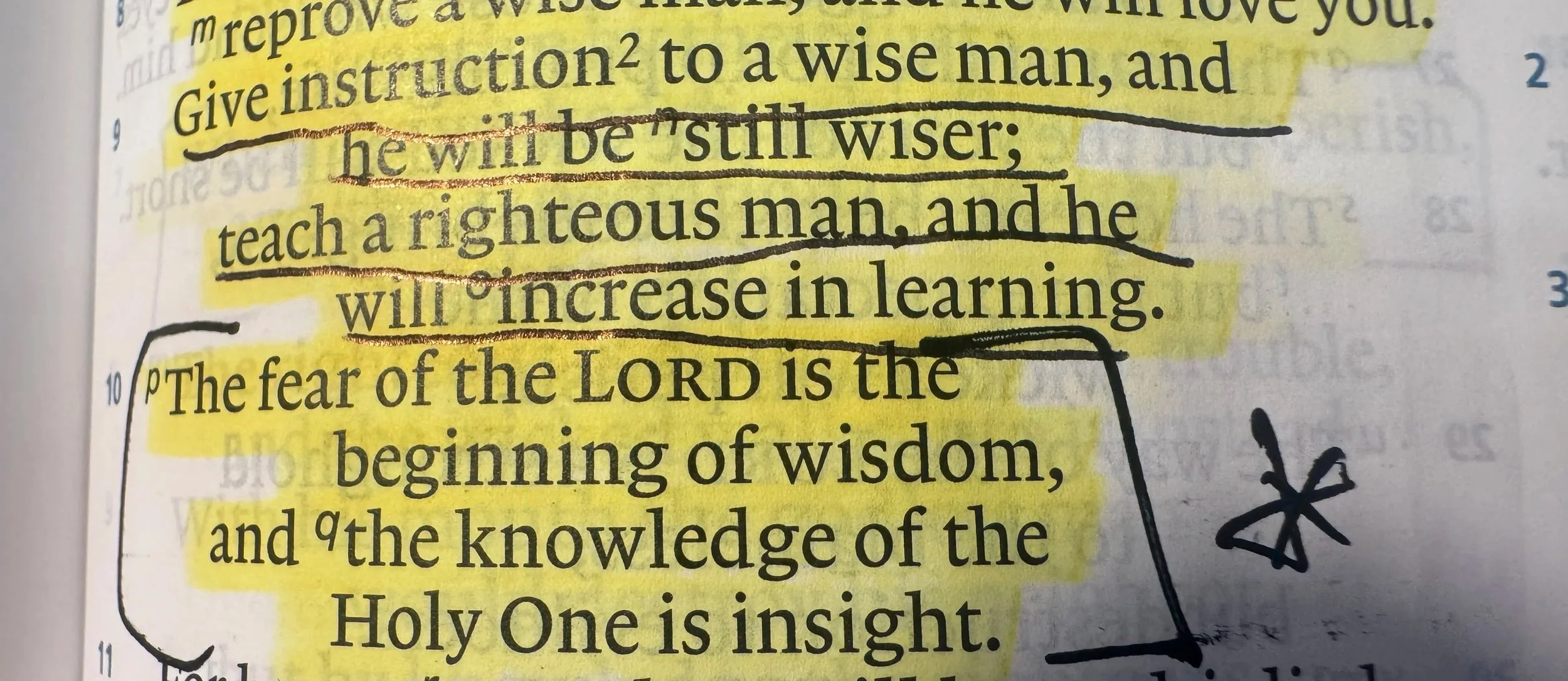
Give instruction to a wise man, and he will be still wiser. Teach a righteous man, and he will increase in learning.
I put the Bible down and sat with it for a while. Because that verse, in a few words, captures something that I think most men get exactly backwards — and that the examined life gets exactly right.
The Wrong Assumption
Most men operate on a quiet assumption they have never examined. It goes something like this: wisdom is a destination. There is a point — somewhere ahead of where I am now — where I will have learned enough. Where I will have arrived. Where the questions will be largely settled and the hard work of figuring things out will be mostly behind me.
It is a comfortable assumption. It is also completely wrong.
And the men who hold it most firmly tend to be the men who stopped growing some time ago without noticing.
You have met this man. He has strong opinions on almost everything. He is not particularly curious about perspectives that differ from his own. He interprets questions as challenges and instruction as criticism. He has been the same man, more or less, for the last twenty years — and considers that consistency a virtue rather than a warning sign.
Solomon is not describing that man as wise. He is describing him as a fool. The previous verse makes it plain: do not reprove a scoffer or he will hate you. The scoffer — the man who cannot receive instruction — is not simply unpleasant. He is not growing. And a man who is not growing is slowly becoming less than he was.
What the Verse Actually Says
Look at what Solomon does in verse nine. He does not say give instruction to an ignorant man and he will become wiser. He says give instruction to a wise man and he will be still wiser.
The assumption built into that sentence is remarkable. The wise man — the man who has already done the work, who has already thought carefully, who has already accumulated knowledge and experience and hard-won understanding — that man is the one most positioned to benefit from further instruction.
Not because he knows nothing. Because he knows enough to know how much he does not know.
The wise man receives instruction well precisely because wisdom has taught him something about the nature of wisdom — that it is not a fixed quantity you accumulate until the jar is full, but a living thing that either grows or diminishes. The moment you stop receiving instruction is the moment you start losing ground — slowly, quietly, without any single dramatic failure to mark the turning point.
The righteous man increases in learning…..Not achieves learning…..Increases. The verb implies ongoing motion. It’s a direction rather than a destination.
What This Looks Like in Practice
The man truly living the examined life is always learning. Always willing to accept instruction. And always aware — genuinely, not performatively — that he has never learned everything.
This is not false humility. It is accurate assessment. The humble man in Proverbs is not the man who pretends to know less than he does. He is the man who knows precisely what he knows and precisely where his knowledge ends — and who holds both of those things clearly without inflation or deflation.
He reads. Not to confirm what he already believes but to be genuinely challenged and genuinely enlarged by what others have thought carefully about.
He listens. Not waiting for his turn to speak but actually attending to what is being said — with the genuine possibility that the person across from him knows something he does not.
He receives correction. Not without discernment — not every correction is wise and not every critic deserves a hearing — but without the defensive brittleness of a man whose sense of self depends on being right. He can be wrong without being undone by it. He can be corrected without being diminished by it.
And he returns to the same texts — the same books, the same Scripture passages, the same foundational ideas — and finds something new each time. Not because the text has changed. Because he has.
The Examined Life and the Open Hand
There is a connection here to everything The Gentlemen's Study is built around that I want to name directly.
The examined life — the life of honest self-reflection, of deliberate character formation, of the willingness to look clearly at who you are becoming — requires exactly the posture Solomon is describing in verse nine.
You cannot examine your life honestly if you have decided in advance what you will find. You cannot grow if you have concluded that growth is mostly behind you. You cannot receive instruction if you have arranged your life so that nothing and no one can challenge what you already believe.
The man who is always learning is the man who holds his knowledge with an open hand — firmly enough to stand on it, loosely enough to receive more.
That is not weakness. That is wisdom. And Solomon says it produces more wisdom still.
The Question Worth Sitting With
Here is what verse nine asked me this morning, and what I want to leave with you.
When was the last time you genuinely changed your mind about something that mattered?
Not a trivial preference. Not a small practical adjustment. A real change — in how you see something, how you approach something, what you believe about something — that came because you received instruction honestly and followed where it led.
If you have to think hard to remember the last time that happened — that itself is worth examining.
The wise man increases in learning. The righteous man is always willing to be taught.
That is the examined life. Not the life of the man who has arrived.
It is the life of the man who knows he never will. Sit with that for awhile.
Pull up a chair. You're welcome here.
— Keith
The Room That Shapes The Man


From The Desk | The Gentlemen’s Study
There is a room in my house that most people would walk past without a second glance. No wide screen television. No gaming setup. No recliner pointed at a wall of entertainment. Just a desk, a chair, a lamp, bookshelves, and of course…books. A notebook sitting open beside whatever I am currently reading. A pen worth writing with. A window that lets in the kind of light that makes the morning feel like it has a purpose. It is the most important room in my house. Not because of what it contains. Because of what happens there.
What a Room Communicates:
Every space a man inhabits communicates something — to the people who enter it and to the man himself. The space you retreat to when the obligations fall quiet and the hours finally belong to you says something about what you value. What you think is worth your time. What kind of man you believe yourself to be.
A room organized around passive consumption says one thing. A room organized around active engagement says something entirely different.
The study — the desk, the books, the chair positioned for thought rather than collapse — is a daily declaration. It says: I am a man who takes the life of the mind seriously. Who believes that thinking carefully is worth protecting time for. Who understands that the hours I spend in this room are shaping me in ways that the hours I spend anywhere else are not.
That declaration does not require a large room. It does not require an expensive library or a perfectly curated aesthetic. It requires intention. A corner of a room treated with purpose is a study. A magnificent space treated casually is just furniture.
The Historical Weight of the Space:
The study as a dedicated space for reading, writing, and reflection has a long and serious history. It appears in the homes of ministers, lawyers, physicians, statesmen, and philosophers across centuries — not because these men shared an interior design preference, but because they understood something about how serious work actually happens.
Charles Spurgeon had a library of twelve thousand volumes that he called his tools. Abraham Lincoln worked through the night in his White House study on the arguments that shaped a nation. C.S. Lewis had his rooms at Magdalen College where the thinking that produced the Narnia chronicles and the great works of Christian apologetics took shape quietly, over years, in the presence of books and paper and the discipline of a man who showed up to his desk.
These were not men who waited for inspiration. They were men who created the conditions for it. The study was not where they retreated from their work. It was where they equipped themselves for it.
There is a reason the men whose names we still know almost universally had a version of this space. The study is not incidental to the examined life. It is one of its primary instruments.
What the Study Does to a Man:
Let me be specific because I think the case for a dedicated study space is usually made in vague terms that don’t actually change anyone’s behavior.
The study slows you down. In a world optimized for speed and stimulation, a room with no screen and no notification pulls you into a different register. The pace of thought required to read seriously, to write carefully, to sit with an idea long enough to understand it — that pace is itself formative. A man who spends consistent time in a room that demands slowness becomes a slower man in the best possible sense. More deliberate. Less reactive. More capable of the kind of sustained attention that serious work requires.
The study builds an interior life. The man who never has a quiet space — who fills every gap with noise and stimulation — will eventually lose access to his own thinking. He will not know what he believes until someone tells him. He will not know what he feels until it becomes a problem. The study is where a man stays acquainted with himself. Where he processes rather than just experiences. Where the accumulated weight of a life gets examined rather than simply accumulated.
The study produces the man who has something to say. The men whose company you find genuinely enriching — the men who think carefully and speak with authority, who have genuine convictions and can give an account of them — those men did not arrive there by accident. They arrived there through years of reading, thinking, writing, and returning to a space that demanded their full attention.
The study is where that formation happens. Quietly. Without fanfare. One morning or evening at a time.
The Theological Dimension:
I want to say something here that I believe goes deeper than the practical case.
The Great Commandment calls a man to love God with all his heart, soul, strength — and mind. That last word is not decoration. It is a command. The man who never thinks carefully, never reads seriously, never creates the conditions for genuine reflection — that man is not loving God with his mind. He is coasting.
The study is where the mind gets exercised. Where Scripture gets read slowly enough to actually form convictions rather than merely provide content for a daily checkbox. Where the books that sharpen theological understanding get the sustained attention they require. Where prayer moves from hurried transaction to genuine dialogue because the man in the room has finally slowed down enough to listen.
The Puritans — men who thought more carefully about the nature of human beings than most of us ever will — understood this with remarkable clarity. They produced their extraordinary theological literature not because they were academics by profession but because they believed that clarity of thought was a form of faithfulness. That the man who understood what he believed and why he believed it was better equipped to live it, defend it, and pass it on.
The study was where that work happened.
It still is.
Building Your Own:
I want to close with something practical because I think the historical and theological framing can make this feel like something reserved for a certain kind of man — the scholar, the minister, the man with the right credentials and the right library.
It is not.
The study I am describing is accessible to any man willing to make one decision: that some portion of his private hours belongs to formation rather than only to entertainment.
It starts with a chair worth sitting in for an extended period. A surface for writing. A lamp with enough light. And a book — not decorative, not aspirational, but actually being read.
That is the study in its most essential form. Everything else is refinement.
What matters is not the room. It is the decision to treat the room — whatever room it is, however modest — as a place where something serious happens. Where the man who walks in is expected to engage rather than simply consume. Where the hours spent are building something rather than only passing.
The room that shapes the man does not have to be grand.
It has to be intentional.
The photographs attached to this piece are from my own study — the space where the episodes of The Gentlemen’s Study are conceived, researched, and written. It is not a showroom. It is a working room. And it is, without question, one of the places where I do my best thinking.
If it inspires you to claim a corner of your own home for the same purpose — that is the whole point.
Pull up a chair. You’re welcome here.
— Keith
The Smoking Room at the End of My Driveway

From The Desk | The Gentlemen's Study
There is a chair on my back patio that knows things about me.
Not literally, of course. But if you want to understand a man — the version of him that exists when the performance stops and the obligations fall quiet — you could do worse than to spend some time in the space he retreats to when the day is finally his.
Mine is a back patio in North Texas. Nothing elaborate. Nothing designed to impress. A chair, a small table, and on the right kind of evening, something worth smoking and something worth thinking about.
It is, without question, my favorite place in the world.
A Thread I Didn't Know I Was Pulling
I did not always understand why the patio mattered so much to me. I knew I valued the time. I knew it was where I decompressed most fully, where the noise of a long shift finally fell away, where something quieter could surface and be heard.
But I did not have a framework for what was actually happening in those hours until I started researching Episode 2 of The Gentlemen's Study — the episode on the history of cigars, spirits, and gentleman's culture.
What I found changed how I understood my own patio.
The research took me back further than I expected. To the Taíno people of the Caribbean, who greeted Columbus's ships with gifts of tobacco leaves — leaves that Columbus's men threw away, not yet understanding what they had been given. To the pipe circles of the Plains nations, where sharing a smoke was a covenant — a ritual that marked time as set apart, that sealed agreements, that said this moment is different from the ordinary moments before and after it.
To the coffeehouses of Restoration London, where a penny bought any man a seat at the table and a pipe to smoke while he argued about ideas with whoever happened to be present. Where Lloyd's of London was born. Where the London Stock Exchange began. Where the institutional architecture of modern commerce grew out of accumulated conversations between men sitting in leather chairs with tobacco smoke thick in the air.
To the Victorian gentlemen's club — the smoking room in particular — where the real conversation began after the formal dinner ended. Where the servants had withdrawn and the port decanter was making its way around the table and the cigars were lit and the men who ran the British Empire finally said what they actually thought.
A thread runs through all of it. Across centuries and cultures and continents — men have always needed a space set apart from ordinary time. A place where the armor comes off. Where the performance stops. Where honest conversation becomes possible because the usual social defenses have been laid aside.
I looked at my back patio differently after that.
What the Patio Actually Is
My patio is my smoking room.
Not in the Victorian sense. There is no dark paneling, no leather wingback chairs, no decanter making its way around a mahogany table. But in the essential sense — the one that has survived every change of era and culture — it is exactly that.
It is the space where the day ends and something else begins.
There is a ritual to it that I have come to take seriously. The deliberate selection of the evening's cigar. The careful cut. The lighting — done properly, unhurried, the way it deserves to be done. These small actions are not incidental. They mark the transition. They say to the part of your brain that is still running through the day's unfinished business: that is done. This hour is different. Pay attention.
The same is true of whatever is in the glass. Not because the drink itself is the point — but because the act of pouring something worth drinking and sitting down with it communicates something to yourself. An acknowledgment that the day has earned its end. That the man who never stops is not more virtuous than the man who knows when to sit down. He is simply more depleted.
I have come to believe that decompression is not weakness. It is maintenance. And the man who never maintains himself eventually has nothing left to give the people who depend on him.
What Happens in the Quiet
The patio is where I do some of my clearest thinking.
Not the urgent kind — the problem-solving, the planning, the list-making that occupies most of a working man's mental bandwidth during the day. That thinking happens at the desk, in the car, during the shift. The patio is for something different.
The kind of thinking that only happens when you stop trying to think. When you simply sit with what is already there.
Questions surface that the noise of the day crowds out. Convictions clarify. Things that seemed tangled in the afternoon have a way of unknotting themselves in the quiet of an evening with something good burning slowly in the ashtray.
I am convinced this is not accidental. There is something about genuine stillness — the deliberate, protected, unhurried kind — that the soul requires and rarely receives. We were not built for constant stimulation. We were built for rhythms. Work and rest. Noise and quiet. The active and the contemplative.
The back patio enforces the rhythm. It is hard to be in a hurry when you are smoking a cigar that demands an hour of your unhurried attention.
The Conversations Worth Having
One of the things I value most about cigar culture is what it does to conversation.
There is something about two men sitting together with good cigars that changes the register of what gets said. The shared ritual — the lighting, the unhurried pace, the understanding that neither of you is going anywhere for the next hour — creates the conditions for conversations that do not happen in most settings.
Not the surface conversation. Not the exchange of information and opinions that passes for conversation in most of modern life. The deeper kind. Where something real gets said. Where a man tells you what he is actually carrying rather than what he wants you to think he is carrying.
I have had some of the most important conversations of my life on a patio with a cigar in my hand. With my sons. With old friends. With men I had only just met but who turned out to have something worth saying. Those conversations did not happen over text messages. They did not happen in a conference room. They happened in a space set apart — in unhurried time, around something worth sharing.
The Victorian gentlemen understood this about their smoking rooms. The men of the London coffeehouses understood it about their penny admissions and their pipe smoke and their hours of argument. Some conversations require a particular setting. And the setting requires intention.
Your Smoking Room
I want to say something practical before I close — because I think the historical framing can make this feel like it belongs to another era or another kind of man.
It does not.
Your smoking room does not need dark paneling or leather wingback chairs. It does not need to be indoors or formally appointed or any particular size. It needs to be yours — a space you have claimed, a time you have protected, a ritual you have built around the deliberate act of stopping.
A back porch in Texas. A garage with a decent chair and a good lamp. A corner of the yard where the neighbor's noise does not reach. Whatever space you can find and protect — that is enough.
What matters is the intention you bring to it. The decision that this hour belongs to something other than productivity. That the man who sits here is not available for the urgencies that will always present themselves if you let them.
Because here is what I have learned from my patio — and from the history of men who understood this long before I did:
The thread that runs from the pipe circles of the Americas to the coffeehouses of London to the smoking rooms of Pall Mall runs straight to wherever you choose to sit down and be fully present.
You are not just enjoying a cigar on a Tuesday evening.
You are participating in something that has mattered to men for a very long time.
Pull up a chair. You're welcome here.
— Keith
The Man Who Stopped Reading - And What He Lost

From The Desk | The Gentlemen's Study
There is a particular kind of man I have noticed over the years.
He is not unintelligent. Not incurious. Not lazy in any obvious sense. He works hard, provides for his family, takes his responsibilities seriously. He is, by most external measures, a man doing what a man is supposed to do.
But somewhere along the way he stopped reading. Not dramatically. Not with any conscious decision. It just happened — the way most important losses happen — quietly, gradually, and without anyone noticing until the absence has been present long enough to feel normal.
He still consumes information. Enormous quantities of it, actually. Headlines, podcasts, social media, commentary, opinion. The flow of content through his daily life is essentially continuous. He knows what is happening in the world. He has opinions about it. He can hold his own in most conversations.
But he is not thinking his own thoughts.
He is living on borrowed ones.
What Borrowed Thoughts Look Like
The borrowed thought is not a lie. That is what makes it so difficult to identify.
It is an idea you absorbed rather than arrived at. A position you hold not because you examined it and found it solid, but because the people around you hold it, or the culture endorses it, or the voices you listen to have been saying it long enough that it feels like your own conclusion.
Borrowed thoughts feel like convictions. They have the same emotional texture. They produce the same confidence in conversation. The man who holds them is genuinely unaware, most of the time, that they are not entirely his.
The test comes when they are challenged.
The man of genuine conviction — the man who arrived at what he believes through reading, through thought, through the sustained engagement with serious alternatives — can give an account of himself. He knows not just what he believes but why. He has considered the objections. He has sat with the hard questions long enough to develop real answers rather than reflexive ones.
The man living on borrowed thoughts cannot do this. When his positions are pressed he retreats to assertion. When his assumptions are questioned he responds with irritation rather than argument. Not because he is dishonest, but because he never did the work that would give him something more substantial to stand on.
What Reading Actually Does
I want to be specific here because I think the case for reading is usually made in terms too vague to change anyone's behavior.
Reading builds attention. This is the most practical benefit and the most underappreciated. The capacity for sustained attention — the ability to stay with a single thing long enough to actually understand it — is being systematically eroded by the format of modern information consumption. Every time you read a serious book you are exercising that capacity. You are training yourself to resist the pull of distraction. You are building a muscle that will serve you in every domain of your life.
Reading forces genuine intellectual encounter. When you scroll through social media or watch a news segment, the ideas you encounter have already been processed for you. Simplified. Framed. Often distorted in the direction of whatever emotional response the platform is designed to provoke. When you read a book — especially a serious one, especially one written by someone who disagrees with you — you encounter the actual argument. The full version. You have to engage with it on its own terms before you can evaluate it. That is a fundamentally different intellectual experience.
Reading gives you language for what you already know. There are things I have observed, convictions I have carried, truths I have sensed without quite being able to articulate. And then I read something — a paragraph, sometimes a single sentence — that says exactly what I have been trying to say. With precision and clarity I did not have. That experience is not just satisfying. It is formative. Because once you have the language for an idea you can think about it more clearly, defend it when it is challenged, and build on it.
Reading connects you to the conversation of history. Every serious book is an entry into a conversation that has been going on for centuries. The questions being asked about human nature, about justice, about faith, about how men ought to live — these are not new questions. They have been wrestled with by brilliant minds across thousands of years. When you read seriously you gain access to that conversation. You are no longer limited to the wisdom available within your immediate social circle or your current cultural moment. You can consult Augustine and Spurgeon and Lewis and Chesterton. You can sit with men who faced harder circumstances than yours and thought more carefully about them than most of us ever will.
The Theological Argument
I want to say something here that I believe goes deeper than the practical case.
The Great Commandment calls a man to love God with all his heart, soul, and mind. That last word is not decoration. It is a command. The man who never thinks carefully, never reads seriously, never submits his assumptions to genuine examination — that man is not loving God with his mind. He is coasting on inherited ideas and hoping they hold.
The Reformed tradition has always understood that the life of the mind is inseparable from the life of faith. The Puritans produced their extraordinary theological literature not because they were academics by profession but because they believed that clarity of thought was a form of faithfulness. That the man who understood what he believed and why he believed it was better equipped to live it, defend it, and pass it on.
Spurgeon's twelve thousand volumes were not a decoration. They were tools. He read because he believed the man who stood in the pulpit — or who led his family, or who engaged his community — owed those people his best thinking. And his best thinking required raw material that only serious reading could provide.
That principle does not belong to ministers alone. It belongs to every man who has responsibility for others.
Which is every man.
A Book That Changed Things
I want to tell you about a specific moment. Not to review a book but because it illustrates something that no argument can quite capture.
I was twenty-seven years old. Two small sons at home. Early in my law enforcement career. By most external measures things were going reasonably well.
I picked up a book called Developing the Leader Within You by John Maxwell. And somewhere in the middle of it Maxwell made a point that I could not shake — that leaders are always being watched. That the people who look to you are paying attention to everything. Not just your decisions. Your habits. Your attitudes. The way you carry yourself when things are hard.
I thought about my two young sons.
And I asked myself a question I had not quite asked before in those terms: what kind of man are they watching?
That question — sitting in the middle of a book, at twenty-seven years old — was one of the most clarifying moments of my adult life. I made a decision. Not because of a resolution or a program or an accountability partner. Because a book asked me a question I could not ignore.
Those two young sons are grown men now. One of them became a father himself recently. And I held his daughter for the first time and thought about that twenty-seven year old with a book in his hands.
The decisions he made because of that question had consequences that reached further than he could have imagined.
That is what a book can do.
What It Actually Takes
I want to close with something practical because I think the case for reading can feel aspirational in a way that produces admiration rather than action.
Reading is not academic. It is not reserved for a certain kind of man. It is a discipline — exactly like any other discipline — that is built through repeated intentional practice.
You do not need hours. You need consistency. Ten minutes tonight is more valuable than an elaborate reading plan you abandon in three weeks. One book finished slowly and thoughtfully will do more for you than five books skimmed for content.
The activation energy is the only real obstacle. And ten minutes is enough to get past it.
Here is the question worth sitting with — not as a source of guilt but as a genuine honest inventory:
What are your private hours building?
The man who fills them with passive consumption is, slowly and without any single decision, becoming a man whose inner life is thin. Who does not know what he thinks until someone tells him. Who has inherited his convictions rather than earned them.
The man who fills some of those hours with reading is building something. Slowly. Without fanfare. But the compound interest of a reading life is real, and it shows — in how he thinks, how he speaks, how he handles pressure, how he leads the people who are watching him.
Your sons are watching.
Your grandsons will watch.
What kind of man are they going to see?
Pull up a chair. You're welcome here.
— Keith
Sprezzatura — The Lost Art of Wearing It Lightly

There is a word that has largely disappeared from our cultural vocabulary. An Italian word, coined in 1528 by a diplomat named Baldassare Castiglione in a book called The Book of the Courtier. The word is sprezzatura.
It does not translate cleanly into English. The closest approximation is something like — the art of making difficult things look effortless. Or perhaps more precisely: the discipline of wearing your accomplishments lightly.
Castiglione's argument was revolutionary for his time. For most of the medieval period, a gentleman was simply a man of good birth. Your bloodline determined your standing. Character was largely beside the point.
Castiglione disagreed. He argued that genuine gentility was not inherited — it was cultivated. The true gentleman was educated, physically graceful, musically literate, capable of intelligent conversation on any subject. He was brave without being brutal. Generous without being wasteful. Accomplished across many domains.
And he carried all of it without requiring the room to notice.
That last part is sprezzatura. The man who has worked hard, built something real, developed genuine competence — and who wears all of that without announcement. Without performance. Without the need for acknowledgment.
What Sprezzatura Is Not
It is worth being precise about what Castiglione was not describing. He was not describing false modesty — the practiced self-deprecation of a man who actually wants very much to be noticed. That is performance in the opposite direction, and it is just as hollow.
He was also not describing indifference. The man of sprezzatura cares deeply. He has worked. He has prepared. He has developed real competence through real effort. The effortlessness is genuine — earned through discipline, not pretended through affectation.
What he is describing is a particular relationship between a man and his own accomplishments. An interior settledness that does not require external validation to remain intact. The man who knows what he has built does not need to tell you about it. He simply lives it.
Why It Disappeared
We live in an era that has inverted sprezzatura entirely.
The dominant cultural posture of our moment is the opposite — call it performed effort. The carefully curated social media post that reveals just enough struggle to make the achievement more impressive. The casual mention of the difficult thing you accomplished. The strategic vulnerability that is not really vulnerability at all.
We have built an entire attention economy around the display of accomplishment. And the man who does not display — who simply does the work and lets it speak — is almost invisible in that environment.
There is also the masculinity problem. The dominant cultural conversation about manhood has produced two equally hollow options. On one side, the man who must constantly perform toughness, dominance, and achievement for an audience. On the other, the man who has been told that confidence itself is suspect — that the accomplished man should apologize for his accomplishments.
Sprezzatura is neither of these. It is the third option that the current conversation has largely forgotten. The man who is genuinely strong, genuinely accomplished, genuinely confident — and who carries all of that with such ease that it never becomes a burden to the people around him.
What It Looks Like in Practice
The man of sprezzatura walks into a room and does not need to establish himself. His presence does that work without assistance.
He is prepared — thoroughly, seriously — but he does not advertise his preparation. He simply performs at the level his preparation has produced.
He does not complain about difficulty. Not because he is unaware of it, but because complaint is a form of demanding acknowledgment. The man of sprezzatura does the difficult thing and moves on.
He listens more than he speaks. When he speaks, it is worth hearing. The discipline of not filling every silence with the sound of his own voice is part of what makes his voice worth attending to when he uses it.
He is at ease with himself. Not complacent — ease and complacency are very different things. But genuinely comfortable in his own skin, in his own convictions, in the life he has built. That ease is contagious. People relax around him because he is not performing for them.
And perhaps most importantly — he does not need your agreement to remain confident in what he believes. He has done the work. He knows what he thinks and why he thinks it. Your disagreement is interesting to him, perhaps worth engaging with, but it does not destabilize him. That interior groundedness is the deepest expression of sprezzatura.
The Cigar Connection
There is a reason this concept appeared in an episode about cigars and gentlemen's culture. The connection is not accidental.
A fine cigar rewards exactly the qualities sprezzatura describes. Patience. Attention. The willingness to slow down and be present without requiring anything dramatic to be happening. The man who smokes a good cigar well — who gives it the time it deserves, who does not rush it, who is content in the quiet of the hour — is practicing a small version of the same discipline.
He is not performing his enjoyment for anyone. He is simply there. Present. At ease. The cigar burning slowly in the ashtray, the evening doing what evenings do, a man comfortable enough in his own company that he does not need to fill the silence.
That is sprezzatura in its most accessible form. Available to any man willing to slow down long enough to practice it.
A Standard Worth Recovering
Castiglione wrote The Book of the Courtier in 1528. Nearly five hundred years ago. And the ideal he described — the accomplished man who wears his accomplishments lightly, who is genuinely strong without needing to announce it, who is at ease in any room because he is at ease within himself — that ideal has not aged.
It has simply gone out of fashion.
Which means it is available to any man willing to be countercultural enough to pursue it.
The noise around us rewards the performer. The man who posts the most, announces the most, displays the most. Sprezzatura asks for something different. It asks for the discipline to build something real — and then to let it speak for itself.
That is a harder standard. And a more interesting one.
Pull up a chair. You're welcome here.
— Keith
On Slowing Down

A brief reflection from the host
We live in a world that rewards speed.
Fast opinions. Fast takes. Fast decisions. The man who hesitates is left behind — or so we're told.
But I've spent 25 years watching what happens when men act without thinking. When emotion replaces judgment. When the urgent crowds out the important. And I've come to believe that one of the most countercultural things a man can do in 2026 is simply slow down.
Not because he's disengaged. Not because he doesn't care. But because he understands that the best thinking happens in the quiet. That character is formed in the unhurried moments. That the examined life — the one Socrates said was worth living — requires time and stillness that most men never give themselves.
The Gentlemen's Study exists because of that conviction.
Pull up a chair. There's no rush here.
— Keith