Cigars, Whiskey, and the Glory of God
A word to the listener who wonders how I reconcile the patio with the pew
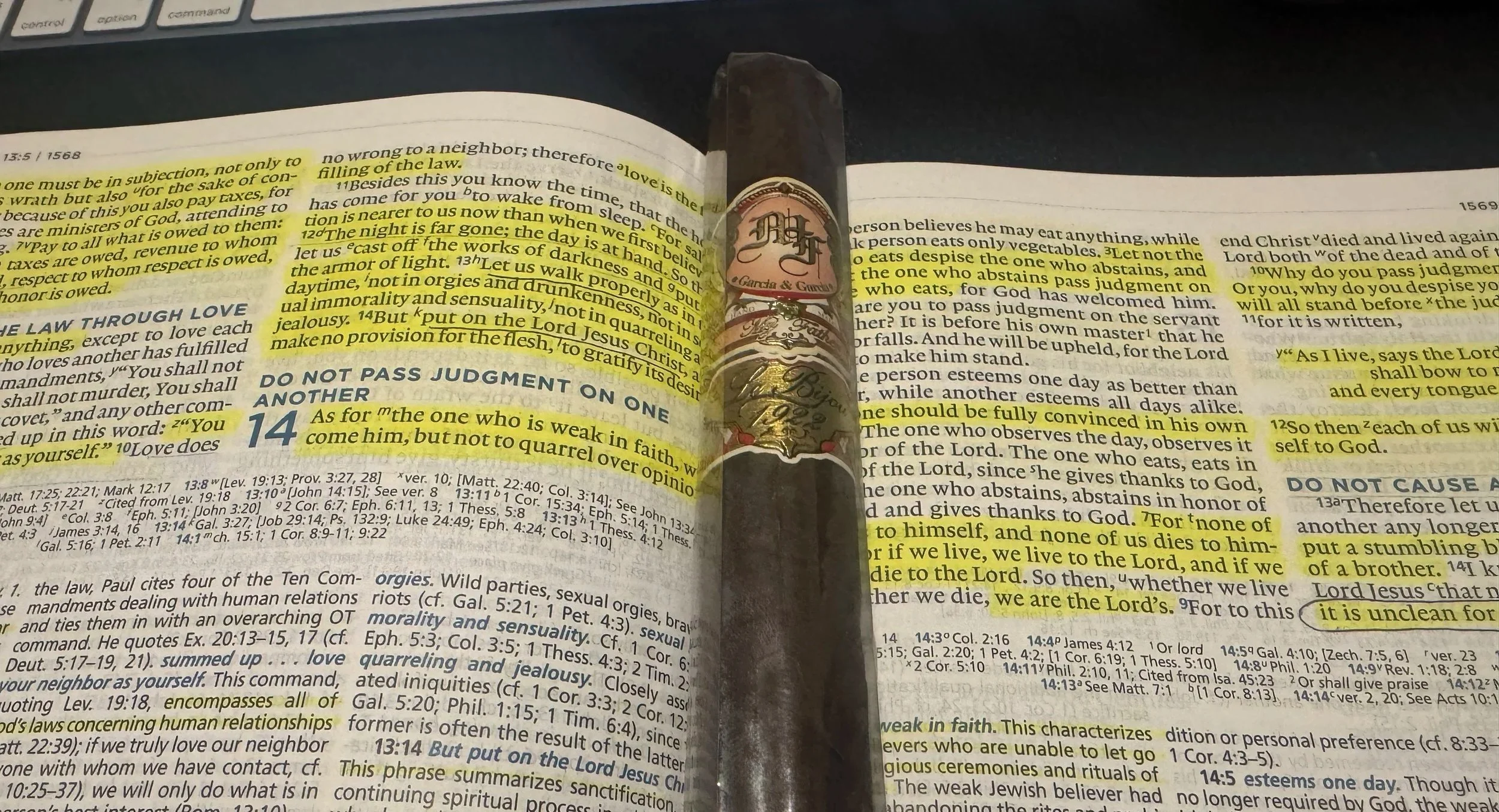
From the Desk/The Gentlemen’s Study
I get the question from time to time. Since the podcast has begun, I have gotten it a couple of times from listeners and I assume it will come more and more with the growth of the show. Someone listens to an episode, hears me mention the My Father Le Bijou I enjoyed on the patio the night before or the pour of Woodford Reserve Double Oaked that accompanied a good book, and they write in to ask — sometimes with genuine curiosity, sometimes with concern — how I reconcile that with being a Christian.
It's a fair question. And because it keeps coming, I want to answer it properly rather than in passing. Not defensively. Not apologetically. But theologically — because that's where the answer actually lives.
The short answer is this: a cigar and a glass of whiskey enjoyed in moderation are not sin. The Bible does not say they are. And the attempt to make them sin — to build a prohibition that Scripture does not build — is not holiness. It is legalism. Those are two very different things, and a gentleman ought to know the difference.
What the Apostle Paul Actually Said
The clearest framework for this conversation comes from the Apostle Paul, and he addressed it directly — not because cigars existed in the first century, but because the underlying question is timeless: what freedoms does the Christian have in areas the Bible does not explicitly prohibit?
In Romans 14, Paul is addressing a real dispute in the early church over food sacrificed to idols and the observance of certain days. His counsel is careful and nuanced. He distinguishes between what Scripture commands and what individual conscience may require. He writes:
"One person believes he may eat anything, while the weak person eats only vegetables. Let not the one who eats despise the one who abstains, and let not the one who abstains pass judgment on the one who eats, for God has welcomed him."
— Romans 14:2–3
The principle Paul is establishing is Christian liberty — the freedom a believer has in areas where God has not spoken a prohibition. The strong believer, the one who understands his freedom in Christ, is not to be condemned by the one who, out of personal conviction, abstains. And vice versa — the one who enjoys the freedom is not to look down on the one who does not.
Paul extends this principle in 1 Corinthians 10:31, where he writes:
"So, whether you eat or drink, or whatever you do, do all to the glory of God."
— 1 Corinthians 10:31
This is the theological hinge of the entire question. The issue is not whether a cigar or a glass of whiskey exists on a list of forbidden things — they don't. The issue is whether you can enjoy them in a manner that honors God. Whether they are held loosely, governed by self-control, and kept in their proper place. That is the standard Scripture actually sets.
The Conscience Clause
Paul does add an important qualification that any honest treatment of this subject must include. In Romans 14:23 he writes: "Whatever does not proceed from faith is sin." And earlier in the same chapter: "Each one should be fully convinced in his own mind."
What this means practically is that Christian liberty is not a license to override your own conscience. If a man is personally convicted that he should not drink whiskey — not because the Bible forbids it, but because of his own history, weakness, or conscience before God — then he should abstain. To violate your own conscience, even in something Scripture permits, is sin for that man.
This is why I am not here to tell every Christian gentleman to light a cigar and pour a drink. There are men for whom total abstinence is the right and wise choice — because of a history with alcohol, because of a tendency toward excess, because of a weak brother nearby who would be harmed by the example. Paul addresses all of that too, and it deserves to be taken seriously.
What I am saying is simply this: abstinence is not automatically holiness, and enjoyment is not automatically sin. The determining factors are conscience, self-control, and whether the thing is received with gratitude and kept in its proper place.
Where Sin Actually Lives
Scripture is clear about where the line is drawn. The sins Paul names are drunkenness and gluttony — not drinking and eating. Galatians 5:21 lists drunkenness among the works of the flesh. Proverbs 23:20–21 warns against those who drink to excess. The prohibition is on overconsumption, on the loss of self-control, on appetite that has become master rather than servant.
The issue is not the substance. The issue is self-control — the fruit of the Spirit that governs all of our appetites, not just the culturally acceptable ones.
I track my cigar and drink consumption deliberately — not because I believe two cigars a week and an occasional pour of bourbon are sins requiring management, but because I believe any appetite left unexamined tends to expand. The man who governs his appetites is a free man. The man whose appetites govern him is not — regardless of what substance is involved.
What Legalism Actually Is
There is a word for the practice of building moral prohibitions that Scripture does not build, and adding them to the law of God as though they carry the same weight: legalism. It is not a minor error. Paul addresses it sharply in Colossians 2:20–23, asking: "If with Christ you died to the elemental spirits of the world, why, as if you were still alive in the world, do you submit to regulations — Do not handle, Do not taste, Do not touch?" He calls these things regulations "according to human precepts and teachings" and notes that they have "an appearance of wisdom in promoting self-made religion and asceticism," but are of no value against the indulgence of the flesh.
The appearance of wisdom. That is a precise and sobering description. Legalism looks serious. It sounds holy. But what it actually does is substitute human tradition for biblical authority and in doing so, it binds consciences that Christ has set free.
I say this not to be dismissive of the brother or sister who personally abstains — that choice can be genuinely wise and godly. I say it because the posture of treating abstinence as the only acceptable Christian position, and looking sideways at the man who enjoys a cigar on his patio, is a posture Scripture does not support.
The Prince of Preachers Had Something to Say About This
Charles Haddon Spurgeon — the Prince of Preachers, the most celebrated Baptist minister of the nineteenth century, a man whose sermons are still read and studied worldwide — was a well-known and unapologetic cigar smoker. He made no attempt to hide it and saw nothing wrong with it.
The most documented account of his position came in 1874 at the Metropolitan Tabernacle. Spurgeon had invited the American Baptist pastor Dr. George Pentecost to share the pulpit. Spurgeon preached on the necessity of giving up sin, and then invited Pentecost to make the application. Pentecost — unaware that Spurgeon smoked — proceeded to preach passionately against cigars, sharing his own struggle to give them up and declaring the practice sinful for a Christian.
When Pentecost sat down, Spurgeon rose. The congregation held its breath. What he said is documented in Arnold Dallimore's biography of Spurgeon:
"Well, dear friends, you know that some men can do to the glory of God what to other men would be sin. And notwithstanding what brother Pentecost has said, I intend to smoke a good cigar to the glory of God before I go to bed tonight."
— Charles Spurgeon, Metropolitan Tabernacle, 1874
The statement caused considerable public controversy. Spurgeon responded in a letter to the editor of the Daily Telegraph — not by backing down, but by explaining his theology with characteristic clarity:
"No Christian should do anything in which he cannot glorify God; and this may be done, according to Scripture, in eating and drinking and the common actions of life. When I have found intense pain relieved, a weary brain soothed, and calm, refreshing sleep obtained by a cigar, I have felt grateful to God, and have blessed His name."
— Charles Spurgeon, letter to the Daily Telegraph, 1874
It is worth noting that some versions of the Tabernacle quote add the phrase "it is a kind of incense drifting to heaven," and while that colorful addition circulates widely, it does not appear in Dallimore's sourced account. The core statement — that he intended to smoke a good cigar to the glory of God — is well-documented and indisputably Spurgeon's own words.
So Here Is Where I Land
I smoke a cigar most weekends. I enjoy a pour of Bourbon, Rye, or Scotch on occasion — never a second pour, always kept to its proper place. I receive both as good gifts from a generous God, enjoyed in moderation, held loosely, and governed by self-control.
I do not believe this makes me a worse Christian. I do not believe it dishonors God. I believe it reflects exactly what Paul described in 1 Corinthians 10:31 — doing what I do to the glory of God, with gratitude for the good things He has placed in a well-ordered life.
If you are a brother or sister who personally abstains — I respect that entirely. Paul makes room for you, and so do I. But I would gently ask you to extend the same grace in return. The man on the patio with a good cigar and a quiet evening is not necessarily a man in need of correction. He may simply be a man who knows his liberty and exercises it well.
The question Scripture asks is not whether you smoke or drink. The question is whether you can do it to the glory of God — with a thankful heart, a governed appetite, and a clear conscience before Him.
On a good evening, with the right cigar and the right company, I believe you can.
Pull up a chair, you’re welcome here,
Keith