The Man Who Is Never Done Learning
From The Desk | The Gentlemen's Study
I was in Proverbs 9 this morning.
I read one chapter a day — the chapter that corresponds to the day of the month. It is a practice I have kept for years. Thirty-one chapters, twelve passes through the year, and every time I come back to a passage I have read dozens of times I find something I missed before.
That in itself is the point.
This morning verse nine stopped me.
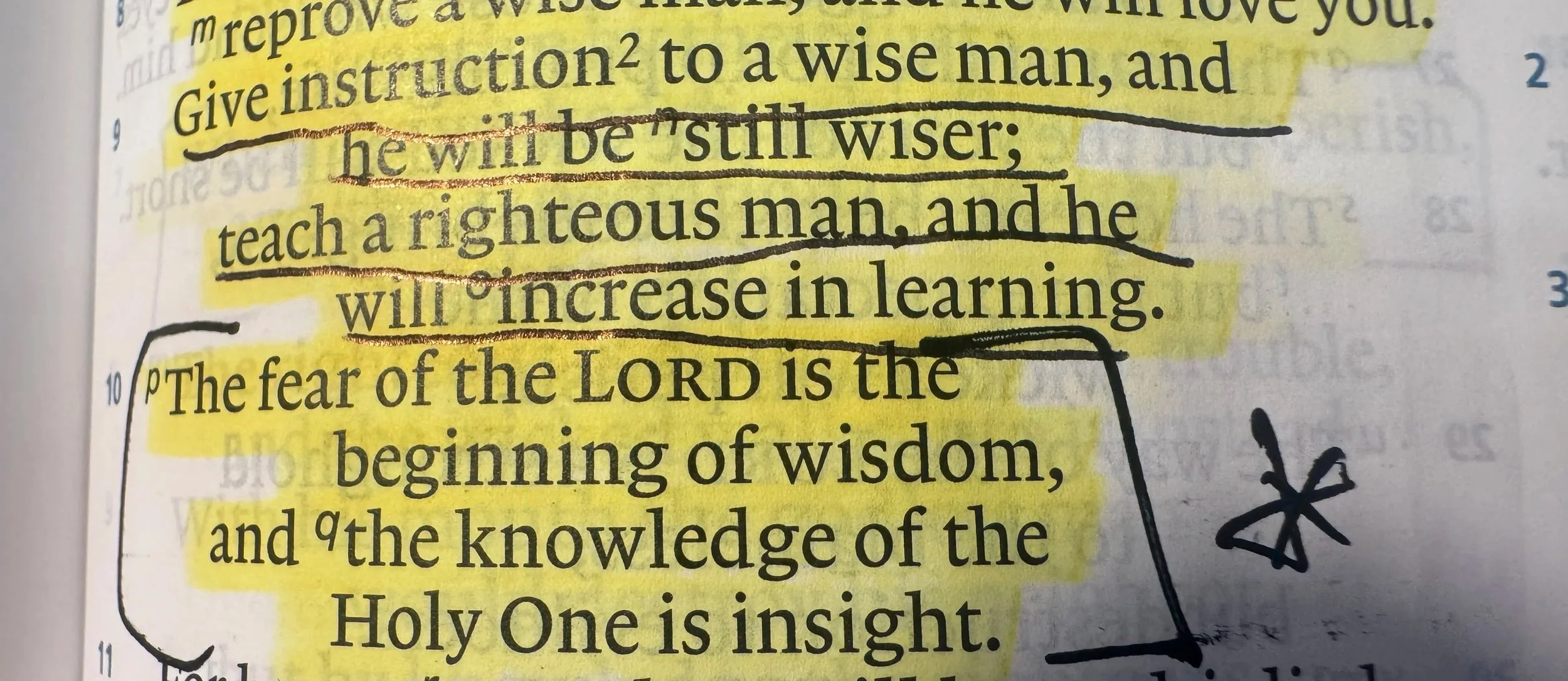
Give instruction to a wise man, and he will be still wiser. Teach a righteous man, and he will increase in learning.
I put the Bible down and sat with it for a while. Because that verse, in a few words, captures something that I think most men get exactly backwards — and that the examined life gets exactly right.
The Wrong Assumption
Most men operate on a quiet assumption they have never examined. It goes something like this: wisdom is a destination. There is a point — somewhere ahead of where I am now — where I will have learned enough. Where I will have arrived. Where the questions will be largely settled and the hard work of figuring things out will be mostly behind me.
It is a comfortable assumption. It is also completely wrong.
And the men who hold it most firmly tend to be the men who stopped growing some time ago without noticing.
You have met this man. He has strong opinions on almost everything. He is not particularly curious about perspectives that differ from his own. He interprets questions as challenges and instruction as criticism. He has been the same man, more or less, for the last twenty years — and considers that consistency a virtue rather than a warning sign.
Solomon is not describing that man as wise. He is describing him as a fool. The previous verse makes it plain: do not reprove a scoffer or he will hate you. The scoffer — the man who cannot receive instruction — is not simply unpleasant. He is not growing. And a man who is not growing is slowly becoming less than he was.
What the Verse Actually Says
Look at what Solomon does in verse nine. He does not say give instruction to an ignorant man and he will become wiser. He says give instruction to a wise man and he will be still wiser.
The assumption built into that sentence is remarkable. The wise man — the man who has already done the work, who has already thought carefully, who has already accumulated knowledge and experience and hard-won understanding — that man is the one most positioned to benefit from further instruction.
Not because he knows nothing. Because he knows enough to know how much he does not know.
The wise man receives instruction well precisely because wisdom has taught him something about the nature of wisdom — that it is not a fixed quantity you accumulate until the jar is full, but a living thing that either grows or diminishes. The moment you stop receiving instruction is the moment you start losing ground — slowly, quietly, without any single dramatic failure to mark the turning point.
The righteous man increases in learning…..Not achieves learning…..Increases. The verb implies ongoing motion. It’s a direction rather than a destination.
What This Looks Like in Practice
The man truly living the examined life is always learning. Always willing to accept instruction. And always aware — genuinely, not performatively — that he has never learned everything.
This is not false humility. It is accurate assessment. The humble man in Proverbs is not the man who pretends to know less than he does. He is the man who knows precisely what he knows and precisely where his knowledge ends — and who holds both of those things clearly without inflation or deflation.
He reads. Not to confirm what he already believes but to be genuinely challenged and genuinely enlarged by what others have thought carefully about.
He listens. Not waiting for his turn to speak but actually attending to what is being said — with the genuine possibility that the person across from him knows something he does not.
He receives correction. Not without discernment — not every correction is wise and not every critic deserves a hearing — but without the defensive brittleness of a man whose sense of self depends on being right. He can be wrong without being undone by it. He can be corrected without being diminished by it.
And he returns to the same texts — the same books, the same Scripture passages, the same foundational ideas — and finds something new each time. Not because the text has changed. Because he has.
The Examined Life and the Open Hand
There is a connection here to everything The Gentlemen's Study is built around that I want to name directly.
The examined life — the life of honest self-reflection, of deliberate character formation, of the willingness to look clearly at who you are becoming — requires exactly the posture Solomon is describing in verse nine.
You cannot examine your life honestly if you have decided in advance what you will find. You cannot grow if you have concluded that growth is mostly behind you. You cannot receive instruction if you have arranged your life so that nothing and no one can challenge what you already believe.
The man who is always learning is the man who holds his knowledge with an open hand — firmly enough to stand on it, loosely enough to receive more.
That is not weakness. That is wisdom. And Solomon says it produces more wisdom still.
The Question Worth Sitting With
Here is what verse nine asked me this morning, and what I want to leave with you.
When was the last time you genuinely changed your mind about something that mattered?
Not a trivial preference. Not a small practical adjustment. A real change — in how you see something, how you approach something, what you believe about something — that came because you received instruction honestly and followed where it led.
If you have to think hard to remember the last time that happened — that itself is worth examining.
The wise man increases in learning. The righteous man is always willing to be taught.
That is the examined life. Not the life of the man who has arrived.
It is the life of the man who knows he never will. Sit with that for awhile.
Pull up a chair. You're welcome here.
— Keith