The True Source of Wisdom
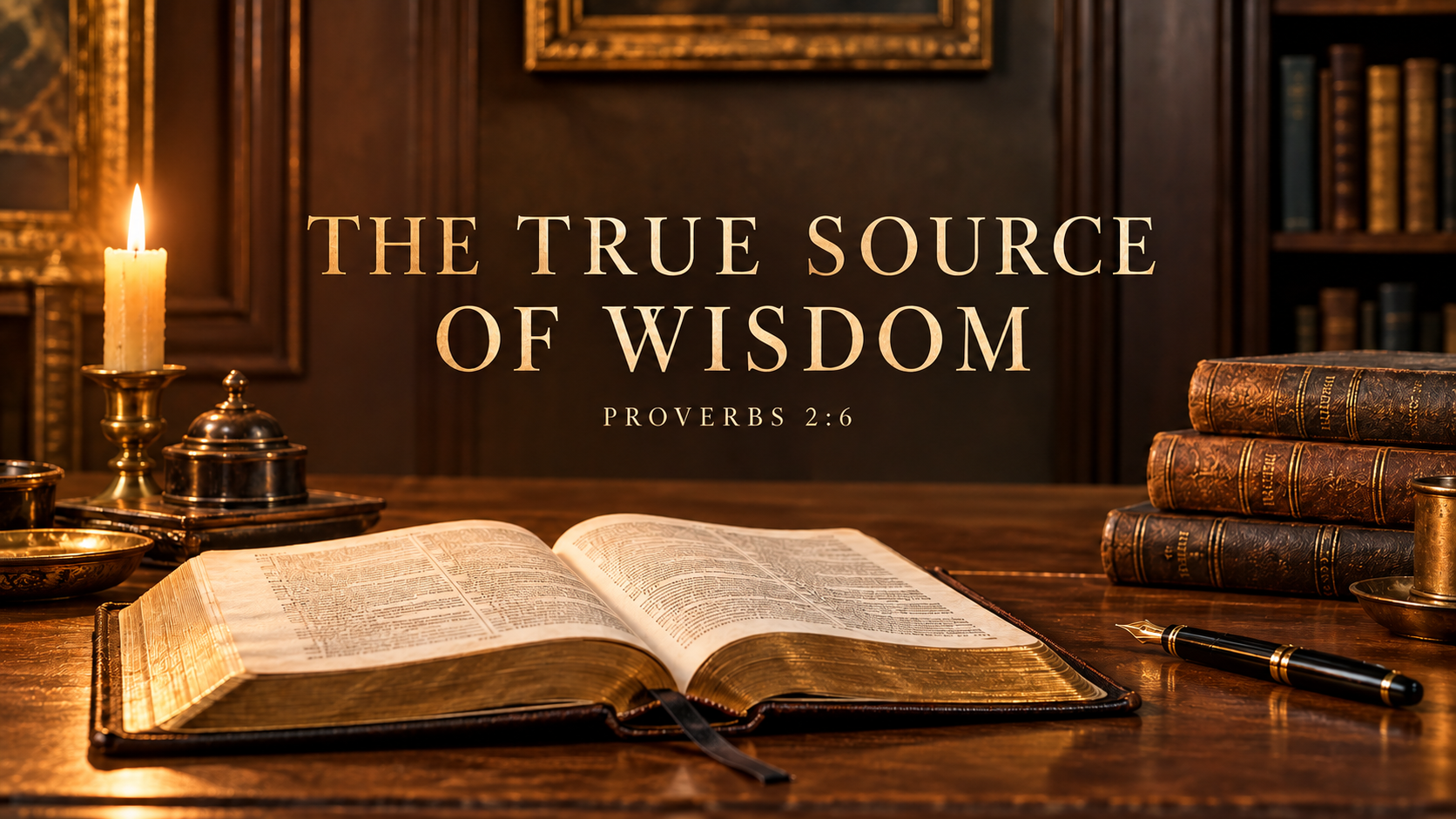
From The Desk | The Gentlemen’s Study
I was in Proverbs 2 this morning.
As I have mentioned before, part of my daily Bible reading, I read the chapter in Proverbs that corresponds to the date. Thirty-one chapters. One for nearly every day of the month. It is a simple practice, but one of its great benefits is that it keeps bringing me back to passages I might otherwise read once, nod at, and move past.
This morning, verse six caused me to pause and ponder.
For the LORD gives wisdom;
from his mouth come knowledge and understanding.
— Proverbs 2:6
There is an entire philosophy of knowledge contained in that one sentence. It tells us where wisdom comes from, how we receive it, and why the truly wise man can never become proud of possessing it.
It also corrects one of the most persistent mistakes made by intelligent men: the belief that wisdom is something we manufacture for ourselves.
The Difference Between Intelligence and Wisdom
We live in an age with almost unlimited access to information. A man can carry more facts in his pocket than the greatest libraries of the ancient world could hold. He can summon an answer to almost any question within seconds. He can listen to lectures, read articles, follow experts, and consume a constant stream of explanation and opinion from the moment he wakes until the moment he goes to sleep.
And yet none of that guarantees wisdom.
Information can tell a man what is happening. Knowledge can help him understand how something works. Intelligence may allow him to analyze a problem faster than the people around him.
Wisdom answers a different question.
What should I do?
How should I live?
What is true, what is good, and what is worth pursuing?
How do I take what I know and place it in the proper order under God?
A man can be highly educated and still ruin his family. He can be professionally accomplished and still be governed by appetite, pride, anger, or fear. He can speak confidently about politics, theology, history, or culture and still lack the judgment to know when to speak, when to remain silent, when to act, and when to wait.
That man may be informed. He may even be brilliant.
But he is not necessarily wise.
The Verse Begins With God
Proverbs 2:6 does not say that the Lord merely approves of wisdom. It does not say that He recognizes it when men achieve it or rewards those intelligent enough to discover it.
It says He gives it.
That means wisdom does not begin with the man seeking it. It begins with the God who possesses it and gives it according to His grace.
That distinction matters because it changes the posture of the entire pursuit.
If wisdom is my achievement, then it becomes another reason to think highly of myself. I read more than other men. I have lived longer. I have made difficult decisions. I have accumulated experience. I have learned from mistakes. Therefore, I am wise.
But if the Lord gives wisdom, then anything genuinely wise in me is received before it is possessed. I may have pursued it seriously. I may have studied, listened, reflected, and learned through years of experience. But I did not create the truth I came to understand. I did not establish the moral order I am learning to recognize. I did not give myself the mind with which I perceive it.
I am a recipient.
That is why genuine wisdom and genuine humility belong together. The wiser a man becomes, the more clearly he should see how dependent he is upon God for everything he knows rightly.
The proud man may know many things. But pride is already evidence that he has misunderstood the most important thing about them.
From His Mouth
The second half of the verse is just as important as the first.
“From his mouth come knowledge and understanding.”
God has not left us to search for wisdom in the dark. He has spoken.
This is where the Christian understanding of wisdom separates itself from vague spirituality and self-help. We are not told to look deeply within ourselves until we discover a private truth that was waiting there all along. We are not told to follow every strong impression, trust every instinct, or treat our own desires as though they carry divine authority.
Wisdom comes from the mouth of God.
For us, that means His Word. Scripture is not one source of wisdom among many equally authoritative voices. It is the standard by which every other voice is judged—including our own.
That is not to say there is nothing to learn outside the pages of the Bible. The world is filled with knowledge worth acquiring. History teaches. Experience teaches. Good books teach. Older men teach. Failure can be a severe but effective instructor. Through common grace, even men who do not acknowledge God can observe His world accurately and say things that are true.
But none of those sources is ultimate. Every lesson, idea, tradition, and piece of advice must eventually stand before what God has spoken.
A man does not become wise merely by collecting more voices. He becomes wise by learning which voice governs all the others.
Seeking What Only God Can Give
There is something else in this chapter that deserves attention.
The verses immediately preceding verse six tell the reader to receive wise words, treasure commandments, make his ear attentive, incline his heart, call out for insight, and seek wisdom as he would seek silver or hidden treasure.
Then comes verse six:
“For the LORD gives wisdom.”
At first glance, those two ideas might seem to pull in opposite directions. Are we supposed to work diligently for wisdom, or are we supposed to receive it as a gift?
Proverbs answers: yes.
The fact that wisdom is given does not make the pursuit unnecessary. It makes the pursuit dependent. We read because God has spoken. We study because truth is worth understanding. We listen because pride makes us poor judges of the limits of our own knowledge. We pray because no amount of study can make the human heart see clearly apart from God’s grace.
The effort is real. But the effort is not sovereign.
This is a pattern found throughout the Christian life. We work, but God supplies. We seek, but God reveals. We discipline ourselves, but we do not transform ourselves by force of will. We use the means He has provided while recognizing that the fruit remains His gift.
That protects a man from two equal and opposite errors.
The first is laziness disguised as dependence: “If God gives wisdom, I do not need to do the hard work of pursuing it.” Proverbs will not allow that. The chapter describes a man searching as though treasure were buried beneath his feet.
The second is self-reliance disguised as discipline: “If I read enough, study enough, and accumulate enough experience, I can make myself wise.” Proverbs will not allow that either. The Lord gives wisdom. It comes from His mouth.
The wise man works diligently with an open Bible and a dependent heart.
Wisdom Is Moral Before It Is Impressive
One of the great temptations in pursuing wisdom is wanting to appear wise.
We want the good answer in the room. We want to be the man others consult. We want the reputation for judgment, depth, and insight. And because that reputation is flattering, it is possible to pursue the appearance of wisdom while quietly avoiding the obedience that wisdom requires.
But biblical wisdom is not a performance of intelligence. It is truth lived rightly before God.
The fear of the Lord is the beginning of knowledge. That means wisdom begins not with intellectual confidence but with reverence, submission, and the recognition that God is God and we are not.
The test of wisdom is therefore not merely whether a man can explain the right course. It is whether he walks in it.
Does his knowledge make him more faithful?
Does his theology make him more humble?
Does his experience make him more patient with younger men who have not yet acquired it?
Does his reading make him easier to teach—or simply harder to impress?
Does he obey what God has already made plain while asking for guidance about what remains unclear?
There is little value in asking God for wisdom regarding some great future decision while disregarding what He has already said about honesty, purity, self-control, forgiveness, work, marriage, worship, and the use of our words.
Often, our problem is not that God has failed to give direction. It is that we are hoping for different direction.
Wisdom Has a Name
The New Testament takes this even further.
Paul describes Christ as “the power of God and the wisdom of God.” Elsewhere he writes that in Christ “are hidden all the treasures of wisdom and knowledge.”
Christian wisdom is therefore not merely a collection of reliable principles. It is inseparable from a Person.
We do not come to Christ because He helps us become slightly wiser versions of the men we already are. We come because our deepest problem is not a shortage of information. It is sin. We do not merely need better advice. We need redemption, a new heart, and the work of the Holy Spirit conforming us to the One who is Himself the wisdom of God.
That is where every merely secular system of wisdom eventually reaches its limit. It may identify good habits. It may describe admirable virtues. It may teach restraint, courage, reflection, and composure. Much of that may be genuinely useful.
But it cannot reconcile a man to God. It cannot forgive sin. It cannot raise a spiritually dead heart or produce holiness from the inside out.
The Christian does not reject every insight found outside the faith. He simply refuses to mistake a signpost for the destination.
The true source of wisdom is God. God has spoken in His Word. And the fullness of His wisdom is revealed in Christ.
Awhile back we discussed the Stoics and the Stoic philosophy. I made clear that I take the time to read and attempt to understand their points, which have validity and practical value for living. There is also wisdom in many of their words. While I admire and appreciate them, I also realize they have their place and that their wisdom falls short. I will go to Solomon over Socrates any day, and I value the words of Christ far superior to an Aurelius, Epictetus, or Seneca without hesitation. For True wisdom, there is none higher than the Creator.
The Question Worth Considering
Proverbs 2:6 leaves me with a question that reaches beyond what I read this morning.
When I need wisdom, where do I actually go first?
Do I begin with Scripture and prayer—or do I begin with my own instincts and ask God to confirm them afterward?
Do I want wisdom badly enough to seek it like treasure, or do I merely want quick guidance when a decision becomes uncomfortable?
And perhaps most searching of all: am I asking God to make me wise, or merely to make me look right?
The distinction is not small.
The world has no shortage of information, opinions, experts, or confident men. What it lacks is wisdom—the kind that begins in the fear of the Lord, receives truth as a gift, submits every competing voice to what God has spoken, and then walks obediently in the light it has been given.
That wisdom cannot be manufactured.
It can only be received.
And the Lord is its source.
Pull up a chair. You’re welcome here.
— Keith